other research
network evolution in a new neighbourhood
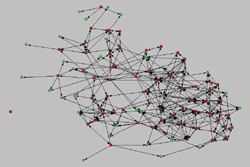 In 2002 I started a complete network
study together with Henk Mulder (department of Sociology, Groningen
University). As a study population we chose households in a part of the
recently built suburb of Kloosterveen in Assen, a small city in the north of the
Netherlands. Especially for Dutch standards, a relatively isolated urban
area under development like this provides an excellent setting to study the
formation of new neighbourhood relationships and their development over the
years.
In 2002 I started a complete network
study together with Henk Mulder (department of Sociology, Groningen
University). As a study population we chose households in a part of the
recently built suburb of Kloosterveen in Assen, a small city in the north of the
Netherlands. Especially for Dutch standards, a relatively isolated urban
area under development like this provides an excellent setting to study the
formation of new neighbourhood relationships and their development over the
years.
In the first wave of the study in 2002, sociology students from
Groningen University interviewed over 60 inhabitants, and assessed the
relationships and exchanges between households. This resulted in detailed
neighbourhood relationship information - and very pretty (Pajek) network
pictures. The results of this wave are available in report form in Dutch.
In winter 2004, in cooperation with
Jacob Dijkstra (department of Sociology, Groningen University) we were able
to collect more data in a second wave of the study. As yet, we have not
been able to process and analyse these new data. If you are interested in
these data send me a
note.
the history of Dutch garden mazes
 Together with fellow enthousiasts I
investigate Dutch mazes and labyrinths in Stichting Doolhof en
Labyrint [Dutch Maze and Labyrinth Society]: their origins, structure,
forms, and current presence in our country. There's more to see and read
about this on our (Dutch) webpages, featuring an extensive overview of Dutch
mazes now open to the public.
Together with fellow enthousiasts I
investigate Dutch mazes and labyrinths in Stichting Doolhof en
Labyrint [Dutch Maze and Labyrinth Society]: their origins, structure,
forms, and current presence in our country. There's more to see and read
about this on our (Dutch) webpages, featuring an extensive overview of Dutch
mazes now open to the public.
My personal research niche in this
project is a study of the history of garden mazes in the Netherlands.
During the Golden Age (1600s) about every Dutch castle or private garden
featured a hedge maze, often of intricate formal design. In addition, mazes
open to the public probably originate in the 17th century Netherlands - at
least four of these were e.g. present in 17th century Amsterdam. Since
there currently is no literature giving a satisfactory overview of this
small but fascinating piece of our history I've aimed at writing one
myself. Since (now vanished) mazes are rarely listed in indexes of
whichever historic work, these writings are slowly developing, however. If
you are interested in progress in this work send me a note.
human
nutrition and dietary habits
In a distant past (1997), I completed my MSc in human
nutrition at the Agricultural
University of Wageningen with a thesis on the homogeneity of the
'Stages of change' scale in the attitude model by Prochaska and DiClemente.
This resulted in an article on the distribution of scores on this scale in
several countries in the European Union (DeGraaf et al, 1997).